
A Letter for MGS
Written by Hanjing Toh
One of the findings from the research was that the communities above the ground directly influence the communities below the ground. What happens to a space when the ones championing the cause are no longer there? The MGS garden was one such example, and the following letter was written by Han Jing and sent as an email to the management of MGS, in hopes of preserving the regenerative garden and bringing across the value of the space and the community above that tends to it.
While the status of the garden is unknown now and we no longer have access, it did propel us to think about all the other forests, regenerative gardens, and farms in Singapore that are slated for removal and destruction. EIA is a standard protocol for any land development project, could we do the same for the regenerative gardens and farms that we have too before they perish?
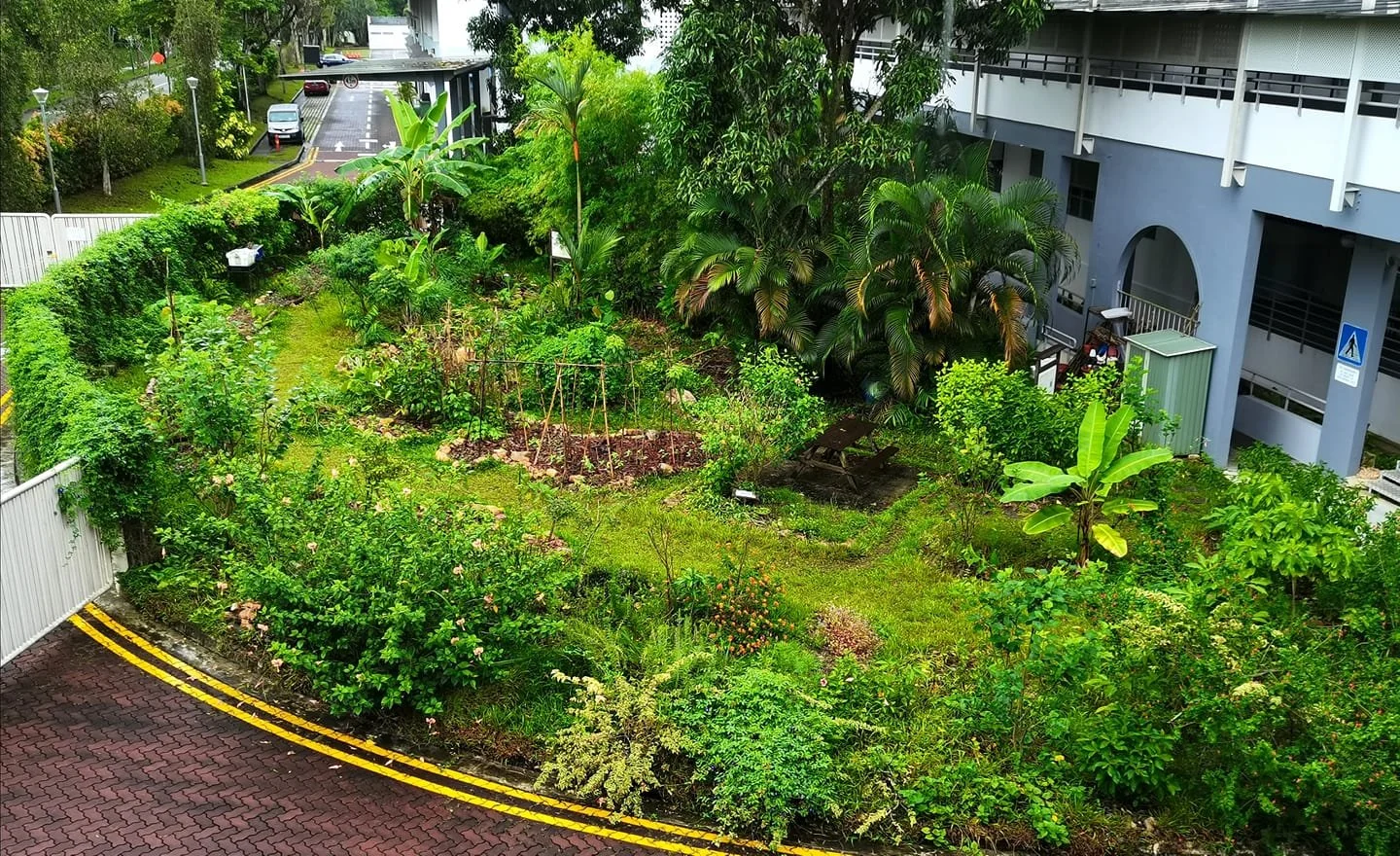
Upon entering the garden at MGS, one would notice that it looks atypical to a manicured garden. The tall bamboo trees shoots up alongside the mango tree, with a pile of unsuspecting leaves by its feet. Unknown to many, this garden is home to a myriad of native edible and regenerative plants, soil creatures, migratory birds and other animals. The dark, loamy soil that lies underneath the mango tree, is the gift and result of 6 years of sweat, tender care and working with nature by Mr Tang and the many volunteers that have contributed to the space.
The garden was not always like that. Prior to 2019, the garden was a plain grass lawn with the mango tree and a pond. The soil was badly damaged and the ground was filled with construction debris leftover from the building of the sports hall. In Feb 2019, Mr Tang Hung Bun, a well respected and dedicated former teacher, farmer, and dragonfly expert, came to MGS to volunteer and help to regenerate the garden. Over the next 3 years, Mr Tang was there almost every day, digging into the ground to remove the construction waste and large rocks, one by one. He worked with the school canteen, collecting 10kg of fruit and vegetable scraps everyday from the stalls from Mondays to Fridays. That is 50kg of food scraps a week that was diverted from the trash! Within the first year, the soil has already began transforming under the care and guidance of Mr Tang, and the MGS Biodiverse garden quickly became a source of inspiration for many people - ranging from environmentalists, urban gardeners, food growers, educators, students and soil scientists in Singapore. Friends and volunteers, myself included, would come over to visit and help out in the garden, sweating under the sun, feeding the soil, enjoying this little refuge in our highly urbanised country.
In 2020, the garden was selected by National Parks Board (NParks) and Living Soil Asia as part of a 3 years soil regeneration project, to study how unhealthy soils in Singapore can be remediated for the betterment of society. MGS was chosen because it has shown great results in transforming clayey orangey soil with poor health, to dark loamy fresh smelling soil that is teeming with life, an indicator of good soil health that is rare in Singapore today. Together with NParks, soil samples were collected and analysed, and the MGS Biodiverse Garden and the regenerative practices became a key subject for an exploratory academic research paper. As one of the fieldworkers attached to MGS garden, I got to spend a lot more time helping out in the garden alongside Mr Tang for a couple of months. It was during this time that I developed a deep sense of appreciation for the garden and the hard work that has gone into improving the ecology of the space. It was during this time that I learned about what it means to work with nature, and to create a thriving garden that sustains itself with little external inputs. I saw firsthand, how Mr Tang managed to grow the sweetest brinjals I have ever had without any use of chemical fertilisers and pesticides.
During this time, I witnessed how the MGS Biodiverse Garden served as a living classroom, not just to me but to MGS girls as well. Every recess, primary school and secondary school students would drop by wanting to help out, or simply to play in the garden and be in nature. During this time, Mr Tang and I would engage with the students, and we would share about the different plants, animals and insects in the garden. In many ways, it was biology, chemistry, geography and social studies all in one. For many, it was the first time that they encountered purple chillis, or the noni fruit, and learn about where bananas come from, and the many varieties of bananas that we have here in Singapore.
In a world where we are increasingly disconnected with our food system, such education is more important than ever. As an educator who has been teaching and sharing in multiple universities over the last couple of years, being able to have access to such a wonderful living classroom and nature centred education is going to help them to cultivate a holistic worldview which will be highly beneficial for their future careers no matter where it takes them. In 2022, Han Jing also led 2 composting workshops for the entire P4 cohort. The students learnt how to make compost in their classrooms as part of a sustainability initiative, and gifted the finished compost to the garden after that. Mr Tang would often be approached by school teachers to teach the students as well.
“In a world where we are increasingly disconnected with our food system, such (nature-centred) education is more important than ever. ”
When covid measures tightened in 2022, Mr Tang was unable to tend to the garden anymore. Worried about the plants and that no one would be there to care for the garden, I offered to step in and care for the space. One month, became two months and soon enough it became a year, and two. During this time, I struggled to go down every day as I had to juggle work and other commitments, and could only come in once or twice a week. During this time, some volunteers came but no one could stay to help long term. Eventually, I managed to rope in two lovely friends, Russell and Esmonde to help with the garden. Esmonde is an eco landscaper that worked on multiple projects in Singapore including several other eco school gardens. Russell stayed near MGS, and was able to cycle down whenever we needed help to check on the garden, compost or water the plants. Whenever there was an urgent need to tend to the garden, such as after heavy rain, Russell would be first to check in on the space. Together, the three of us were able to settle the infrastructure of the garden including building new garden beds, and we were also able to free up time to continue with engage with students and visitors as well.
Beyond the school, the garden has also garnered interest from multiple organisations as well over these couple of years. In 2022, a group of NIE staff visited the garden to learn and volunteer as their year end retreat and service learning session. Another composting learning workshop was held for families in collaboration with Fortitude Culina, a home grown social enterprise that worked with people with special needs. Not forgetting the time when 30 over community gardeners came to MGS Biodiverse Garden to learn about soil regeneration techniques as part of the training for the Soil Regeneration Project. They came to MGS to learn from it as an ecological example in Singapore before going back to work on their gardens.
The garden was a strong testament and example to show that soil restoration and ecological food growing is possible for community gardens in Singapore.
Lastly, I also want to express that none of this would have been possible without Mrs Chan. Since the beginning, Mrs Chan was there to care for us volunteers and the garden, and she would take time out of her very full schedule to tend to the space. Whenever there was a possibility, Mrs Chan would help to facilitate using the garden as the living classroom, bringing the MGS girls into the space for project work or helping to connect us with teachers who wanted their students to learn in the garden for a particular subject. There were times when garden tools got damaged, and Mrs Chan would contribute selflessly as well, just so that the maintainence of the garden could continue in an easeful manner. Throughout my time there, and I believe the volunteers would all agree as well, Mrs Chan went above and beyond to look after the student’s education, the ecology of the garden, and the welfare of the gardeners and we are always grateful for that. As she prepares for her well-deserved retirement, we wish her all the best, and we also hope that the garden could stay on for the sake of the MGS students and our environment. Gardens like these are rare and hard to come by especially in Singapore today, and the volunteers and I do sincerely cherish this space, and hope that it can continue to provide for both students, animals and the larger society.
Warmly with light and care,
Han Jing