People, Soil, and Shared Purpose: Lessons from Resilient Gardens
Written by Hanjing Toh
Learning Trail →Begin Your Regenerative Garden Journey
Overview
Integral to the process of growing and regenerating a community garden is the above-ground community that develops arond it. Gardens in Singapore don't exist in silos; they exist in a community of people, so it's important to grow and nurture human relationships and connections while we grow and nurture the plants in the garden.
In this article, we share some key observations on what makes our gardens grow and regenerate themselves. This includes the resiliency of the human community, as well as the shared values and vision embodied by the gardens. We also share some of the challenges the human community face and how they overcome them.
Community resilience
Gardens supported by a strong human community
One of the key findings in our research was that gardens held strong community resilience in various aspects such as the physical garden care, and overcoming various challenges along the way. It was observed that almost all of the community gardens that we worked with in our research started off with poor soil conditions due to construction debris. Nevertheless, garden soils were able to transform within a short span of 2–3 years under the gardeners' care. This demonstrated not just the resilience that underground soil communities had of rebuilding themselves, but also resilience in the human communities who tend to the gardens.
Gardeners also demonstrated resilience as they overcame challenges and obstacles from stakeholders such as the neighbourhood residents and the school (one of our gardens was situated within a school); the diversity of and also the coming and leaving of garden volunteers. In early 2019, Boon Lay Nature Garden started off with very clayey soil with lots of construction debris, but with the support from the founding team of dedicated garden volunteers, the soil regenerated and supported the growth of various types of crops. Some of the garden volunteers have since left for other projects and commitments, nonetheless, other new volunteers from different races, nationalities and backgrounds have come forward and continued the good work of the founding team.
Shared values and vision embodied by the gardens
Tapping on existing resources
Another key finding was that the regenerative gardens shared common values and vision. For instance, community gardens emphasised on working with existing or renewable resources such as leaves, twigs and logs from the garden vicinity and food scraps from the neighbourhood. Food scraps were found to be the main resource readily available to all the gardens. These scraps were contributed by nearby businesses and households. This finding also reflected that community gardens can help to fulfil the urgent need to reduce increasing food waste in Singapore. At BLNG in JCP, volunteers connected with the fruit stalls in the nearby Kopitiam food court to collect their fruit peels on a weekly basis to create the compost at the garden. This was a great resource as they often had a lot of fruit scraps all at once, which became the ‘greens’ for the compost piles. The gardeners also received regular bags of dried leaves from the NPark’s contracted workers; these dried leaves became the ‘browns’ for the compost piles.
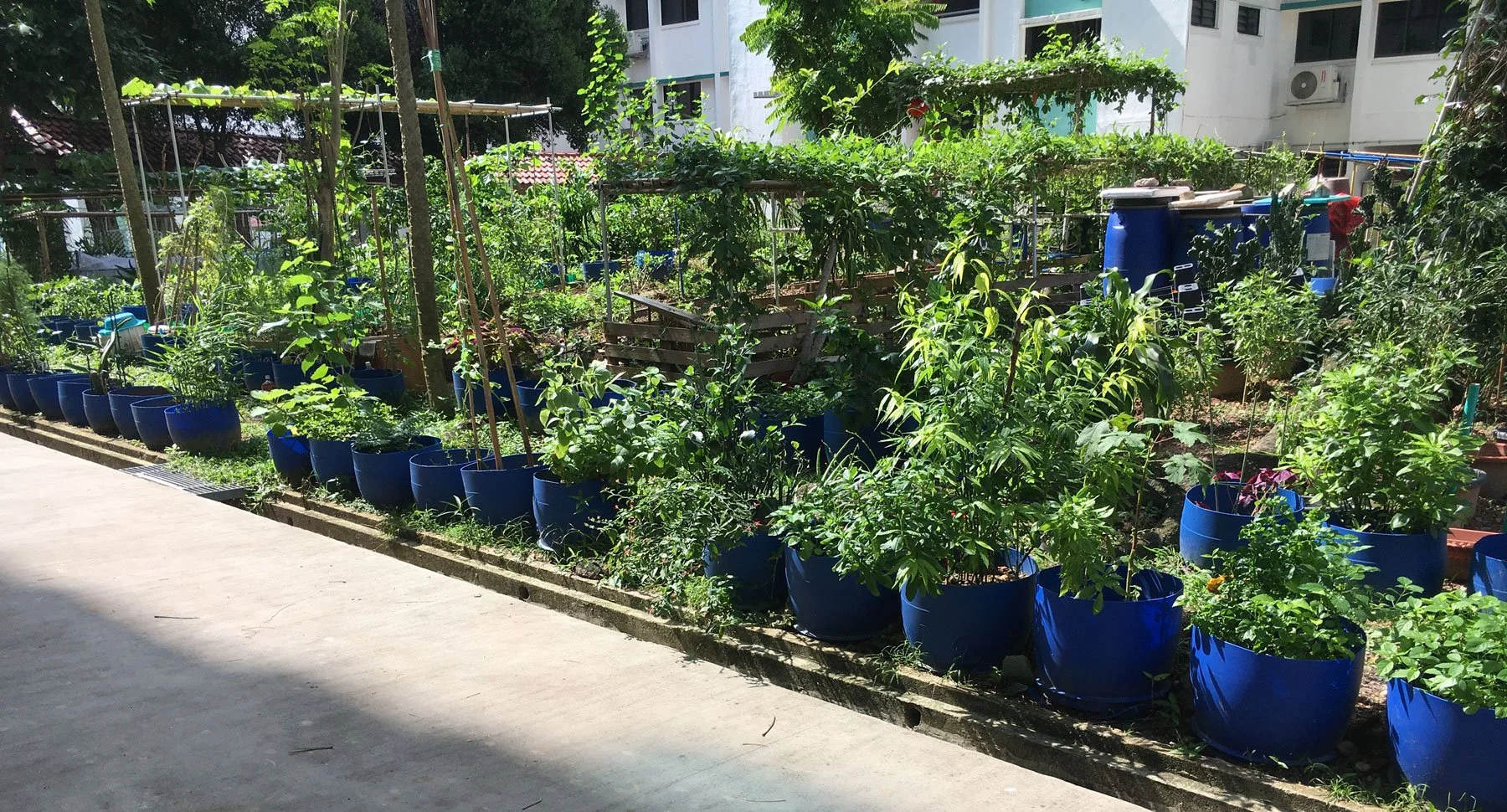
At Bukit Batok garden, bright blue tubs, originally used for commercial purposes had been recycled to be used as plant pots.
However, gardeners sometimes encountered issues accessing these resources. MGS for instance was unable to access fallen leaves as workers hired by NParks contractors needed bags of leaves as evidence of their work to their supervisors. The issue was only resolved when the gardeners managed to talk to an NParks personnel to step in to bridge the communication.
Willingness to share & the value of reciprocity
We noted that the gardeners exhibit values of reciprocity and a willingness to share — from knowledge of planting to seed exchange and cooking and sharing food. The volunteers who contributed food scraps for the garden compost and helped out with gardening tasks were rewarded in kind with harvest from the garden. At Siglap garden, the gardeners will sometimes hold cooking sessions to prepare their harvest from their garden, and partake in communal eating.
Based on our observations, the gardens would invariably have a few key personalities or an initiator that leads the community in their efforts to “glue” and sustain the community. The person/s would help with volunteer management such as setting up working chat groups, posting gardening schedules and assigning tasks to do in the garden. He or she would always be on the lookout to attract new volunteers, or guide gardeners new to soil regeneration. At MAM, the gardening community had been thriving partly because the garden had a strong and dedicated lead gardener who coordinated tasks to be done at the garden itself. He drove a truck to pick up horse manure and other organic materials from other areas and the other gardeners would help add these organic materials to the garden beds to regenerate them. For Siglap South Community Garden, apart from the contribution of food scraps from garden volunteers, the collection of more food scraps and organic material to feed the compost was often carried out by two main members of the community garden who formed the backbone of the community. (Most of the organic material that went into the compost came from the wet markets, coffee grounds from a cafe and wood shavings from a carpenter.)
Challenges faced by the gardeners
Managing human conflict
The gardeners also needed to manage relationships amongst the different stakeholders of the garden. Some of the common sources of conflict stemmed from the different attitudes towards biodiversity in the community. The gardeners emphasised encouraging biodiversity and therefore avoided chemical compounds that would harm wildlife such as fogging, herbicides and pesticides. The immediate community seldom understood these practices, which led gardens to face mosquito fogging and complaints. The gardeners’ aims of maximising ecological functionality contrasts sharply with the surrounding stakeholders’ aesthetic understanding.
For instance, at MGS garden, fogging would be done whenever there were incidents of mosquito complaints. To remediate these issues, the gardeners would find themselves negotiating with the operational staff and/or putting in significant effort with their practices to ease the worries of the community. Wahson and MGS managed to work together with the operational staff to avoid fogging in the gardens, and Wahson negotiated with the landscape contractors to not apply herbicides around the perimeters of the garden.
At Kembangan, the gardener had to adapt the Hugelkultur bed to accommodate neighbours’ perceptions that it looked too much like a burial mound. At Wahson, MGS, JCP, the gardeners would spend extra time and effort to manually cut the leaves and mulching material into small pieces, or arrange logs in straight lines, and would consciously think about maintaining the aesthetics of the garden.
Coming and leaving of people
Another challenge faced by the gardens was the coming and leaving of the volunteers. Most garden volunteers are retirees, housewives or working adults with more freelance work nature or even our foreign community. People may leave the gardens for various reasons, for instance, they may move elsewhere to reside in other parts of the city, or, for our foreign counterparts, they may eventually leave Singapore to return to their home countries. The regular core volunteers would have to step up and even commit to spending more time working at the garden while waiting for new volunteers to come in and support the garden.
Conclusion
Regenerating our gardens takes effort, commitment and dedication from the gardeners. To move forward and sustain our community gardens, there would likely need to be a strong team or at least a few lead gardeners who can be the ‘glomalin’ and bring the community together to hold shared vision and values for the garden. These gardeners would also be key to connecting with different stakeholders for the garden to reach common understanding and alignment of vision and values.